
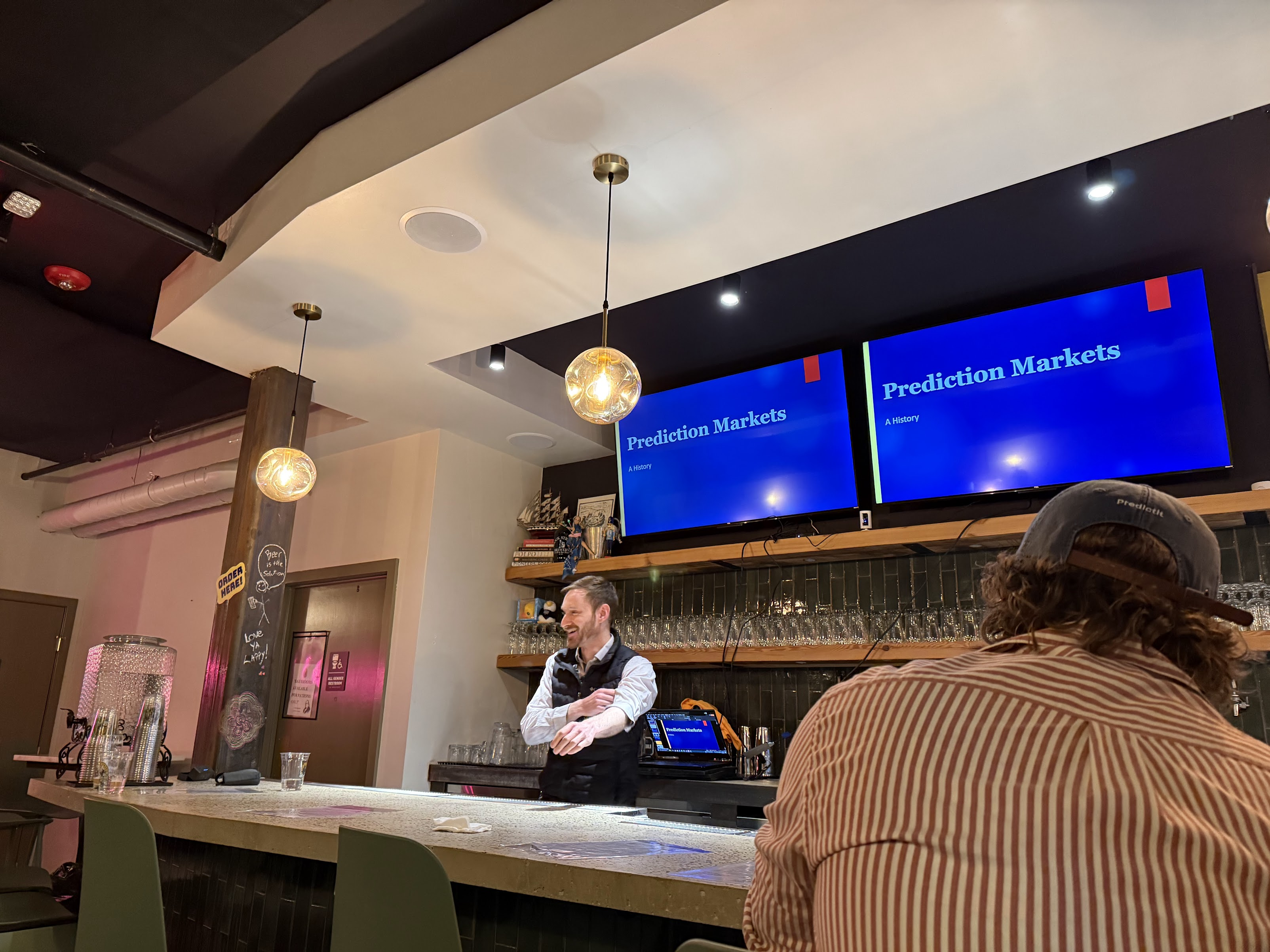
Last week I attended the third meetup by Philadelphia Forecasting Meetup Network on Prediction Markets. I have never played in the prediction markets before, and have no intention to anytime soon, but I have been fascinated by the idea ever since I saw them cropping up in the blockchain space when I was still active there.
Prediction markets take 2 ideas I am personally find challenging: making long term predictions, and making decisions based on your theses. I have read a ton of literature on both these domains but have never been the person who revels in the ambiguity of the space.
The event was fascinating- for one thing I have rarely been in a room with people whose entire careers are based on making predictions – traders, professional poker players, startup founders providing data to prediction markets, app makers, etc. I definitely felt a little bit of an outsider there.
The talk was interesting walking through the history of prediction markets, the challenges of calling the bet in favor of one side or another, when data can be ambiguous (like when governments are closed but not officially reported closed by agencies like the OMB refuse to publish that information, or when dates are involved and the official action is recorded days after the action was executed), and the potential future of prediction markets.
I had not realized that early prediction markets, like The Iowa Electronic Markets (IEM) that began in 1988, were academic efforts that wanted to test whether market mechanisms could aggregate dispersed information better than traditional methods like polling or expert opinion. The early markets also limited the size of the bets which made them better signals than today where people can take out big contracts and then manipulate the markets to win big.
The talk ended with conversations around the future of these markets which will probably be more regulated and how that could be a good thing. The example the speaker gave was interesting: in a more recognized market could airlines hedge their fuel risks via bets on when the Strait of Hormuz would open? Interesting to think about.

